The rules of digital search have changed fundamentally, and the change is not incremental. For years, businesses competed for the ten blue links on a standard results page. Then came AI Overviews, embedding synthesized answers above those links. Now, with Google AI Mode explained as the definitive new frontier, the entire architecture of how users interact with search has been rebuilt from the ground up. Understanding this shift is essential for businesses that depend on digital visibility. Partnering with experienced digital marketing experts who understand how AI Mode works, how it differs from its predecessors, and how to build a content strategy that earns citation within it, is the clearest path to staying competitive in this new landscape.
What Is Google AI Mode and Did It Evolve?
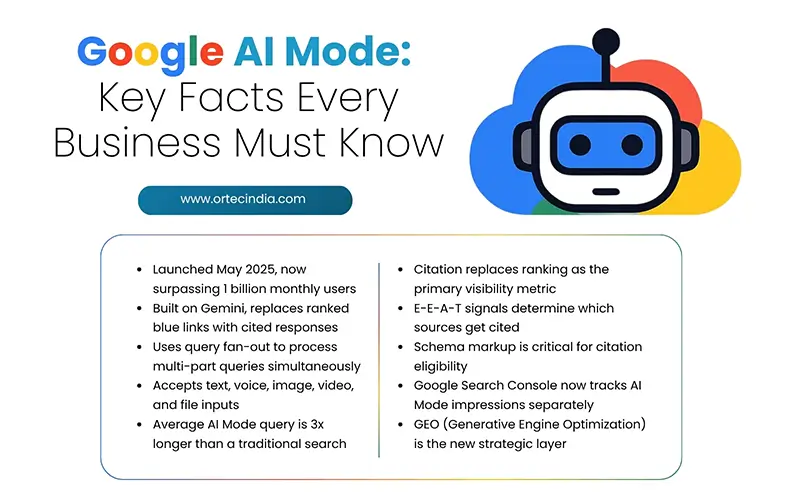
Google launched AI Mode in March 2025 through its Search Labs platform, initially making it available to Google One AI Premium subscribers in the United States. By May 2025, it rolled out broadly to all US users. Built on Gemini 2.5 at launch and subsequently upgraded to Gemini 3.5 Flash as the default model at Google I/O 2026, AI Mode operates as a dedicated conversational interface within Google Search.
Unlike the traditional results page, which presents a ranked list of links for the user to evaluate and click through, AI Mode generates a synthesized, cited response to the user’s query. It supports multi-turn conversations, meaning users can ask follow-up questions within the same thread without re-entering context. It accepts text, voice, images, video, and file inputs. It connects to Google Maps, the Shopping Graph, and the Knowledge Graph, and with user permission, personal data from Gmail and Google Calendar.
The architecture behind this experience is a technique called query fan-out. When a user submits a query, AI Mode does not process it as a single search string. It decomposes the query into multiple sub-queries, runs them in parallel across different data sources, and consolidates the results into one coherent, cited response. This mechanism is what gives AI Mode the capacity to handle genuinely complex, multi-part questions in a single interaction.
Ensure your business earns citation visibility in Google AI Mode with a content strategy built for the AI-first search era.
Google AI Mode Explained: How It Fundamentally Differs From AI Overviews
Understanding the distinction between AI Mode and its predecessor is essential for any business developing a content or visibility strategy.
AI Overviews are embedded summaries that appear automatically at the top of a standard Google results page for queries where the system determines a synthesized answer adds value. They sit above the organic results but alongside them. The user still sees the traditional ranked links beneath. AI Overviews represent an addition to the existing results architecture.
AI Mode is structurally different. It replaces the ranked list entirely. There are no ten blue links. The user enters a dedicated conversational interface and receives a generated, cited response. They can continue the conversation, drill into subtopics, and complete transactions, all without leaving the interface. The user either appears in the cited sources or does not appear at all.
The practical implications of this distinction are significant:
- Citation replaces ranking: In AI Mode, the question is not where a business ranks on page one. The question is whether its content is cited as a source in the generated response. The binary nature of that outcome demands a different optimization strategy entirely.
- Query depth increases: According to data published by Search Engine Journal following Google I/O 2026, the average AI Mode query is three times longer than a traditional search query, and follow-up queries within sessions rose over 40% monthly in the US. Users are not asking short keyword strings. They are conducting extended research conversations.
- Multimodal behavior accelerates: More than one in six AI Mode queries now incorporate voice, images, or video rather than text alone, reflecting a fundamental broadening of how consumers interact with search.
The scale of adoption reinforces the urgency. According to Google’s I/O 2026 announcements, AI Mode surpassed one billion monthly active users globally within twelve months of launch, with queries more than doubling every quarter since May 2025. By comparison, AI Overviews now reach 2.5 billion monthly users. Together, these two surfaces mean that the majority of Google’s estimated 4.5 billion total users now regularly encounter AI-generated content in their results.
What AI Mode Means for Business Visibility and Content Strategy
The shift from ranking to citation changes the calculus of content strategy in several concrete ways.
Authoritative, structured content earns citation: AI Mode’s Gemini model evaluates content for expertise, accuracy, and structural clarity. Content that directly answers specific questions, is organized with clear headers and logical hierarchy, and demonstrates subject matter authority is more likely to be selected as a cited source. Thin, generic, or keyword-stuffed pages are effectively invisible to the citation mechanism.
E-E-A-T signals matter more than ever: Google’s framework of Experience, Expertise, Authoritativeness, and Trustworthiness (E-E-A-T) has always influenced organic visibility. In AI Mode, these signals are amplified because the system is selecting sources to represent as authoritative answers. Businesses that demonstrate genuine subject expertise through detailed, accurate, and well-sourced content build the credibility signals that citation requires.
Schema markup becomes structurally critical: Structured data communicates explicit, machine-readable information about a page’s content, entity type, and relationships. In an environment where an AI model is assembling answers from multiple sources, schema markup provides the precise signals needed to connect a business’s content to the relevant query intent. FAQPage, HowTo, LocalBusiness, and Article schema are particularly valuable.
Conversational content architecture: Because AI Mode users ask questions in natural, extended language rather than keyword fragments, content must be built around complete questions and direct, specific answers. FAQ sections, Q&A formatted blog posts, and structured service descriptions that address the exact questions a target audience asks their devices are the content formats best suited to AI Mode citation.
Zero-click risk and the citation opportunity: Sessions that end without a click to an external website are rising. However, citation within AI Mode carries its own brand value. A business cited as the source for a synthesized response earns implicit endorsement from a system that billions of users trust. The strategic goal shifts from maximizing clicks to maximizing authoritative presence within AI-generated responses.
How AI Is Transforming the Search Optimization Landscape
The emergence of AI Mode reflects a broader transformation in how AI-driven systems process, evaluate, and present information, and that transformation demands a corresponding evolution in how businesses approach digital visibility.
AI-assisted content analysis tools evaluate pages against the signals that generative models use when selecting cited sources, identifying topical gaps, structural weaknesses, and E-E-A-T deficiencies before they affect visibility. AI-powered competitive analysis maps which content formats competitors use to earn citation across AI surfaces, providing a precise roadmap for investment.
AI-enabled content development tools help businesses produce structured, question-and-answer formatted content at scale, maintaining the depth and accuracy that citation selection requires.
The discipline known as Generative Engine Optimization (GEO) has emerged as the strategic layer that sits on top of traditional optimization, focusing on content authority, structured data precision, and topical completeness rather than keyword placement alone.
Businesses that invest in search engine optimization services built for this AI-first environment, rather than services calibrated for a link-ranking world that is rapidly receding, position themselves to earn the citation visibility that AI Mode provides to authoritative sources.
Practical Steps for Businesses to Build Visibility in AI Mode
Adapting to the AI Mode era requires deliberate, technically sound action across content, structure, and credibility signals.
- Audit existing content for citation readiness: Identify pages that address high-value queries and evaluate whether they provide direct, structured answers with sufficient depth and authority to earn citation. Thin pages require substantive expansion.
- Build FAQ and Q&A content systematically: Map the questions your target audience asks at each stage of the buying journey and create content that answers each one directly. Mark up this content with FAQPage schema.
- Strengthen E-E-A-T signals: Add author credentials and expertise signals, cite primary sources, and build content depth around topics where your business has genuine authority.
- Implement and maintain schema markup: Ensure LocalBusiness, Article, FAQPage, and relevant entity schema is implemented accurately and kept current as site architecture changes.
- Optimize Google Business Profile: For local queries, AI Mode pulls business information from the Google Business Profile. A complete, accurate, and regularly updated profile is the baseline requirement for local citation eligibility. Businesses that engage affordable digital marketing services with proven expertise in this emerging discipline gain access to structured audits, content architecture development, and ongoing citation monitoring, capabilities that compound in value as AI Mode’s user base continues its rapid expansion.
Adapting to the Era of Conversational Search
The transition from keyword-matching to AI-driven response generation represents the most consequential shift in digital search since the introduction of the results page itself. For businesses, the practical implication is clear: the content, technical infrastructure, and credibility signals that determine citation in AI Mode must be built deliberately and maintained consistently. Investing in search engine optimization services calibrated for this AI-first environment is no longer a growth initiative. It is a baseline competitive requirement.
Google AI Mode explained is not a feature update to monitor from a distance. It is a structural change in how billions of people find information, make decisions, and discover businesses. The organizations that understand this shift, invest in the content architecture it demands, and work with specialists equipped to navigate its evolving mechanics, will build the kind of authoritative digital presence that earns visibility in AI-generated results today and as this technology continues to advance.
Is your content invisible in AI Mode responses?
Our team builds authoritative, structured content strategies that improve local search rankings and position your business as a cited source in AI-generated results.