
In today’s digital-first landscape, content writing plays a decisive role in how websites rank, engage users, and convert visitors into customers. Search engines are no longer driven solely by keywords; they now prioritize relevance, quality, and user experience. This means businesses must align their content strategies with modern SEO content writing best practices to achieve sustainable visibility and growth. This guide explores proven techniques for search engine optimized content, helping you understand how to optimize content for search engines while writing for real people – not just algorithms.
Boost your search rankings with expert SEO content writing.
Start optimizing your content today.
Understanding the Relationship between Content Writing and SEO
At its core, SEO and content writing are inseparable. Search engines rely on content to understand what a page is about, evaluate its value, and determine whether it deserves a top position in search results. Effective content writing ensures:
- Search engines can easily crawl and index your pages
- Users find relevant, helpful, and engaging information
- Your website builds topical authority over time
Without structured, optimized content, even the most technically sound websites struggle to rank.
Best Content Writing Practices for SEO
Best content writing practices for SEO involve crafting clear, relevant, and well-optimized content that satisfies both readers and search engines. When content is structured properly, enriched with the right keywords, and focused on user needs, it becomes easier to rank higher and drive consistent organic traffic. Below listed are some top content writing strategies for SEO:
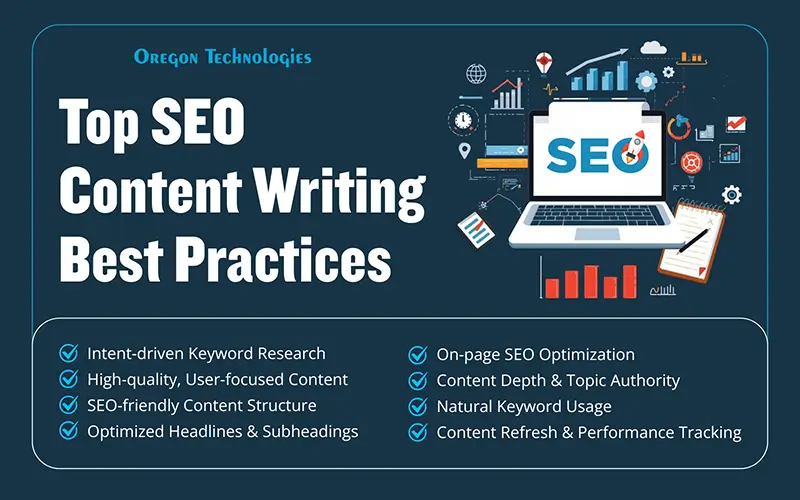
- Start with Intent-driven Keyword Research: One of the most important SEO content writing best practices is keyword research focused on user intent. Rather than targeting broad or highly competitive terms, successful writers analyze what users are truly searching for and why. Key steps include:
- Identifying primary, secondary, and long-tail keywords
- Understanding informational, navigational, and transactional intent
- Mapping keywords to specific pages
Keywords like search engine optimization content and website content optimization should be used strategically—never forcefully. When content naturally answers user questions, search engines reward it with better rankings.
- Write High-quality, User-focused Content: Search engines are designed to mimic human judgment. This means content written purely for rankings often underperforms. Instead, focus on creating value-driven content that solves real problems. High-quality content should:
- Address specific user pain points
- Provide actionable insights and clear explanations
- Be original, accurate, and well-researched
When users stay longer, scroll further, and engage more, it sends positive signals to search engines—improving rankings organically.
- Optimize Content Structure for Readability and SEO: Content structure directly impacts both user experience and search visibility. Clear formatting makes it easier for readers to consume information and for search engines to interpret your content. Best practices for structure include:
- Using one clear H1 and logical H2/H3 subheadings
- Keeping paragraphs concise and scannable
- Adding bullet points and numbered lists where relevant
This structured approach supports website content optimization while improving dwell time and reducing bounce rates.
- Create SEO-friendly Headlines and Subheadings: Headlines play a major role in determining whether users click and continue reading. They also help search engines understand content hierarchy. Effective headlines must include:
- Primary or secondary keywords naturally
- Clearly communicate value
- Match search intent
For instance, subheadings that explain how to write content for better search engine rankings not only improve readability but also help pages rank for long-tail searches.
- Optimize Content for On-page SEO Elements: On-page optimization is a cornerstone of search engine optimization content. Every piece of content should support SEO fundamentals without sacrificing clarity. Key elements to optimize include:
- Title tags and Meta descriptions
- Internal links to relevant pages
- Image alt text with descriptive keywords
- Clean, readable URLs
These elements work together to help search engines accurately evaluate and rank your content.
- Focus on Content Depth and Topic Authority: Search engines increasingly favor comprehensive content that demonstrates expertise. Thin or surface-level articles rarely rank well in competitive spaces. To build authority:
- Cover topics in-depth rather than briefly
- Answer related sub-questions within the same content
- Use semantic keywords and variations naturally
This approach strengthens your overall content writing strategy while positioning your website as a trusted source.
- Optimize Content for Search Engines without Keyword Stuffing: Modern algorithms penalize unnatural repetition, making it essential to focus on context rather than frequency. To properly understand how to optimize content for search engines, follow these guidelines:
- Use keywords where they make sense
- Prioritize flow and readability
- Include synonyms and related phrases
Natural keyword placement improves rankings while maintaining a positive reading experience.
- Improve Content Engagement and User Signals: User behavior is a powerful ranking factor. Search engines analyze how users interact with your content to assess its usefulness. Ways to improve engagement include:
- Writing conversational, easy-to-understand content
- Including examples, statistics, and actionable tips
- Adding clear calls to action
Engaging content keeps users on the page longer, reinforcing search engine trust.
- Update and Refresh Existing Content Regularly: SEO is not a one-time effort. Regular updates signal freshness and relevance to search engines. Content refresh strategies include:
- Updating outdated statistics or references
- Improving formatting and readability
- Adding new insights or keywords
Consistent updates are a critical part of long-term website content optimization.
- Measure Performance and Refine Your Strategy: The final step in effective SEO content writing best practices is measurement. Tracking performance helps you identify what works and what needs improvement. Monitor metrics such as organic traffic growth, keyword rankings, bounce rate, dwell time and conversion rates. Data-driven insights allow you to refine your content strategy for better results.
Implement proven content writing strategies that drive results.
Mastering content writing for SEO requires a balance between technical optimization and genuine value creation. By applying proven SEO content writing best practices, focusing on search engine optimization content, and understanding how to write content for better search engine rankings, businesses can achieve long-term visibility and credibility. Partnering with professional content writing services ensures content is well-researched, user-focused, and strategically optimized. When done right, search engines take notice—leading to higher rankings, stronger engagement, and sustained growth.