
- The Evolution from SEO to AI Search Optimization
- What Is AI Search Optimization?
- Understanding Google AI Mode SEO
- AI Overviews: The New Position Zero
- Answer Engines: The Future of Search
- How to rank in AI Overviews and AI Mode?
- How to Stay Visible in Google AI Overviews
- Key Components of an AI Content Strategy
- Future Trends in AI Search Optimization (2026 and Beyond)
- Best Practices for Businesses
The search landscape is evolving at an unprecedented pace. What once depended heavily on keywords, backlinks, and rankings has now transformed into a more advanced ecosystem driven by intelligence, context, and automation. With the emergence of AI-powered search experiences such as Google AI Mode, AI Overviews, and answer engines, businesses need to rethink their strategies to stay visible online. Welcome to the era of AI search optimization – a next-generation approach that helps brands remain discoverable within AI-driven search environments. As this shift reshapes the way users find information, leveraging digital marketing services can help adapt to new search behaviors and maintain competitive visibility.
In this blog, we will explore how search is evolving, why AI Search Optimization is crucial, and most importantly, how businesses can rank effectively in AI Overviews and AI Mode.
The Evolution from SEO to AI Search Optimization
Traditional SEO has long been the backbone of digital visibility. However, the introduction of AI into search engines has fundamentally changed how results are delivered. Instead of presenting a list of links, search engines now generate summarized, conversational, and context-aware responses.
This shift has led to the rise of AI search optimization, which focuses on:
- Structuring content for AI understanding
- Optimizing for answer-based results
- Enhancing semantic relevance
- Building authority and trust
To understand how SEO has evolved into this new phase, check out Mastering SEO in 2025: Key Trends to Stay Ahead of the Curve
What Is AI Search Optimization?
AI search optimization refers to the process of optimizing your digital content so it can be understood, selected, and presented by AI-powered search systems. Unlike traditional SEO, which primarily focuses on improving rankings through keywords and backlinks, AI search optimization requires creating high-quality, structured, and intent-driven content that directly answers user queries. AI systems analyze context, semantics, and user behavior to generate relevant responses, making it essential for businesses to focus on clarity, authority, and user-centric information. By leveraging AI search optimization, businesses can improve their chances of appearing in AI-generated summaries, answer engines, and advanced search features like AI Overviews and conversational search results.
Start implementing AI search optimization strategies today and stay ahead of the competition.
Understanding Google AI Mode SEO
One of the most significant developments in modern search is Google AI Mode SEO. This feature transforms search into a conversational experience where users can:
- Ask complex questions
- Refine queries
- Receive multi-step answers
Instead of clicking multiple links, users interact directly with AI-generated responses. For businesses, this means visibility depends on whether your content is used by AI, not just whether it ranks.
AI Overviews: The New Position Zero
AI Overviews has emerged as the new “position zero” in search results, where AI-generated summaries appear at the very top, providing users with quick and concise answers. Instead of scrolling through multiple links, users can access key information instantly, making this placement highly valuable for visibility. For businesses, being featured in these AI-driven summaries is now more important than traditional rankings, as it significantly enhances brand exposure even without direct clicks.
Answer Engines: The Future of Search
Answer engines are transforming the future of search by delivering direct, AI-generated responses instead of a list of website links. Powered by advanced AI search optimization, these systems understand user intent, context, and natural language to provide quick and accurate answers in real time. This shift reflects changing user behavior, where people prefer instant information without navigating multiple pages.
Unlike traditional search engines, answer engines focus on meaning rather than just keywords. They analyze multiple data sources and generate concise responses, making search more conversational and personalized. This is especially evident in voice search and AI chat-based platforms. For businesses, this change means that ranking alone is no longer enough. The focus must shift toward creating high-quality, structured content that AI systems can easily interpret and use. Being featured in AI-generated answers increases brand visibility, even if users don’t click through to a website. While answer engines contribute to the rise of zero-click searches, they also offer new opportunities for brand recognition and authority. Businesses that adapt their strategies and invest in digital marketing services can stay competitive in this evolving landscape.
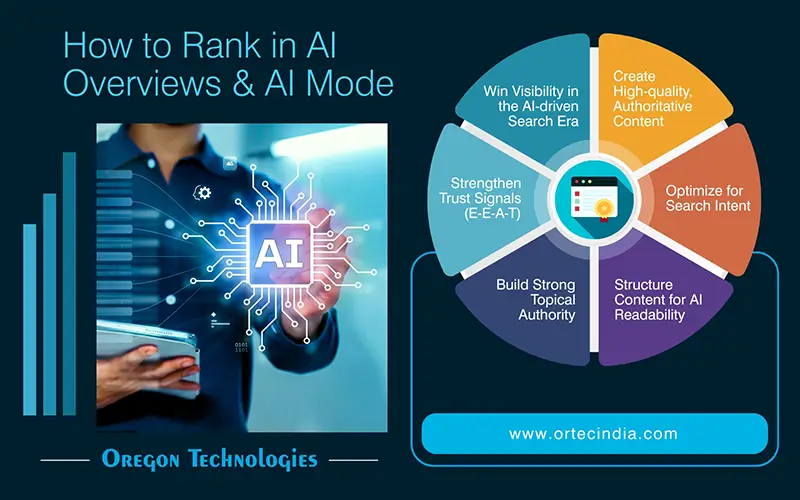
How to rank in AI Overviews and AI Mode?
Here are the most effective strategies:
- Create High-quality, Authoritative Content: To rank in AI Overviews and AI Mode, businesses must focus on producing high-quality, accurate, and in-depth content. AI systems prioritize information that demonstrates expertise, credibility, and real value to users. Instead of generic content, it’s essential to provide well-researched insights, clear explanations, and trustworthy information that positions your brand as an authority in the subject.
- Optimize for Search Intent: Understanding user intent is crucial in AI search optimization, as AI systems are designed to interpret the meaning behind queries rather than just matching keywords. Businesses should create content that directly answers user questions, addresses pain points, and aligns with different search intents such as informational, navigational, and transactional. This improves the chances of being selected for AI-generated responses.
- Structure Content for AI Readability: Well-structured content makes it easier for AI systems to analyze and extract relevant information. Using clear headings, subheadings, bullet points, and concise paragraphs helps improve readability and increases the likelihood of being featured in AI Overviews. Proper formatting ensures that key information is easily accessible and understandable.
- Build Topical Authority: AI systems favor websites that consistently publish content around a specific topic. By creating a cluster of related articles and interlinking them, businesses can establish strong topical authority. This signals to AI that your website is a reliable source of information, improving your chances of ranking in AI Mode and Overviews.
- Strengthen Trust Signals (E-E-A-T): Trust plays a major role in AI-driven search results. Factors such as author expertise, website credibility, backlinks, and user engagement contribute to stronger E-E-A-T (Experience, Expertise, Authority, Trust). Businesses that build and maintain these trust signals are more likely to be featured in AI-generated summaries and answers.
Want to dominate AI Mode and AI Overviews?
Partner with expert digital marketing services to future-proof your search visibility.
How to Stay Visible in Google AI Overviews
Here is how to stay visible in Google AI Overviews:
- Provide Clear and Concise Answers: Start your content with direct, easy-to-understand answers to common questions. AI Overviews prioritize content that quickly delivers value to users.
- Use Conversational Language: Write in a natural, user-friendly tone that matches how people search and speak. This helps AI better interpret and select your content.
- Optimize for Featured Snippets: Structure your content with lists, definitions, and step-by-step formats. AI Overviews often pull information from snippet-style content.
- Keep Content Updated: Regularly refresh your content to ensure accuracy and relevance. AI systems favor up-to-date information when generating summaries.
- Improve Content Depth: Cover topics comprehensively with detailed explanations and supporting information. In-depth content increases your chances of being featured in AI Overviews.
Key Components of an AI Content Strategy
AI content strategy focuses on creating, structuring, and optimizing content that aligns with how AI systems understand and deliver information.
- Topic Clustering: Topic clustering involves creating a group of related content around a central theme. This helps establish authority and makes it easier for AI systems to understand the depth and relevance of your expertise.
- Semantic Optimization: Semantic optimization focuses on using related terms, natural language, and context rather than just keywords. This improves how AI interprets your content and matches it with user intent.
- Content Structuring: Proper structuring with headings, subheadings, and clear formatting enhances readability. It helps AI systems quickly extract key information for summaries and answer-based results.
- Multi-format Content: Using a mix of text, images, videos, and other formats improves engagement and accessibility. AI systems prioritize diverse and interactive content that enhances user experience.
Future Trends in AI Search Optimization (2026 and Beyond)
The future of AI search optimization is set to redefine how users discover and interact with information online. As AI continues to evolve, search will become more predictive, personalized, and deeply integrated into everyday digital experiences.
- Predictive Search: AI will anticipate user needs by analyzing past behavior, preferences, and real-time signals. This will help deliver faster, more relevant results even before users complete their queries.
- Hyper-Personalization: Search results will be tailored to individual users based on their interests, location, and browsing history. This will make search experiences more relevant and user-centric.
- Voice and Visual Search Expansion: Voice assistants and image-based searches will become more common with AI advancements. Businesses will need to optimize for conversational queries and visual content to stay visible.
- Real-time Content Updates: AI will prioritize fresh and updated content by analyzing real-time data. Businesses must keep their information current to maintain visibility in search results.
- Entity-based Optimization: Search engines will focus more on entities like brands, people, and concepts rather than just keywords. This will require businesses to build strong brand authority and contextual relevance.
Best Practices for Businesses
To succeed in the AI-driven search landscape, businesses should:
- Invest in AI Search Optimization Strategies: Businesses should adopt AI search optimization to stay competitive in evolving search environments. This includes optimizing content for intent, structure, and AI-driven ranking factors.
- Partner with Expert Digital Marketing Services: Working with experienced digital marketing services providers helps businesses implement advanced strategies and stay updated with AI search trends. Experts can deliver data-driven insights and scalable solutions.
- Focus on User Intent and Experience: Understanding what users are searching for and why is crucial. Create content that directly addresses user needs, improves engagement and increases the chances of being featured in AI-generated results.
- Build Strong Content Ecosystems: Developing interconnected content through topic clusters strengthens authority and relevance. This approach helps AI systems recognize your website as a reliable source of information.
- Continuously Adapt to AI-driven Changes: AI search algorithms evolve rapidly, so businesses must stay flexible and proactive. Regular updates, performance tracking, and strategy adjustments are essential for long-term success.
The rise of AI-powered search represents a major turning point in digital marketing, and businesses offering digital marketing services must adapt quickly. Traditional strategies are being reshaped by innovations like Google AI Mode SEO, AI Overviews, and answer engines. To remain competitive, businesses must understand how to rank in AI Overviews and AI Mode, implement advanced content strategies, and prioritize authority, trust, and relevance. More importantly, embracing AI search optimization as a long-term approach is essential for sustained success. In this evolving landscape, the future of search is no longer centered on simply ranking pages—it is about positioning your brand as the most reliable answer.