
Writing for search engines used to be simple. Add the right keywords. Keep the page structured. Wait for traffic to grow. That approach no longer works on its own. Search results now include AI Overviews, featured snippets, and direct answers. Readers expect pages that are clear, accurate, and genuinely useful. Following proven SEO content writing best practices helps businesses meet these higher expectations. Many achieve this by partnering with professional content writing services that understand both search performance and reader engagement. This guide covers what works in 2026 and why.
Why the Rules Have Changed
Search behavior has shifted fast. According to AIOSEO’s 2026 SEO statistics report, 60% of searches now end without a click on a website link or a post. This happens because AI Overviews answer many questions directly on the results page.
At the same time, article length still matters. The same report found that posts over 3,000 words earn 3x more traffic than shorter posts averaging 1,400 words. Longer, well-researched pieces continue to outperform thin articles.
While these facts may seem conflicting, they are not so. Both traditional and AI-powered search reward depth and clarity. What has changed is how that depth gets used. A well-written page can rank highly in search results while also being cited in an AI-generated answer. Strong content now serves two audiences: human readers and AI systems.
Build pages that rank well and earns trust with every reader.
Core SEO Content Writing Best Practices
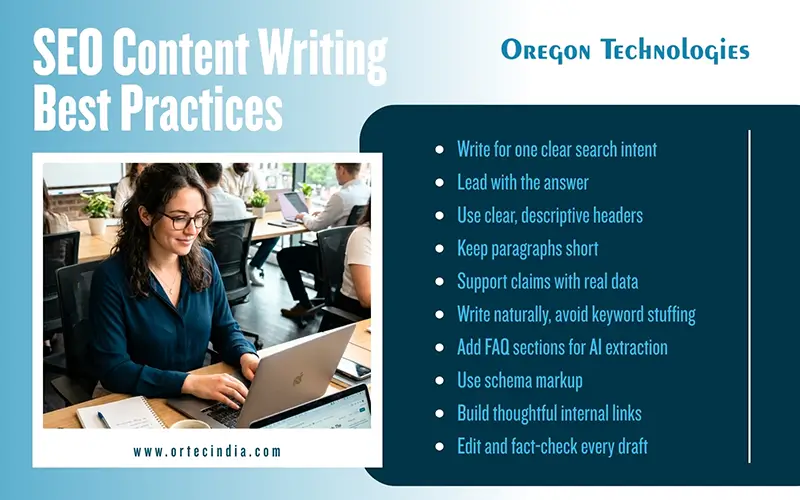
Strong writing starts with a clear plan. The following practices form the foundation of writing that performs well today.
Write for one clear search intent: Every page should answer one main question. Mixing multiple topics confuses both readers and search engines. Before writing, identify exactly what the reader wants to know. Then build the entire page around that answer.
Lead with the answer: Readers and AI systems both look for direct answers early in a page. Avoid long introductions that delay the main point. State the key answer within the first two or three sentences. Add supporting detail afterward.
Use clear, descriptive headers: Headers should describe exactly what each section covers. Vague headers like “More Information” or “Other Details” do not help readers or search engines understand the page. Specific headers make a page easier to scan and easier to cite.
Keep paragraphs short: Long blocks of text are harder to read and harder for AI systems to extract. Two to three sentences per paragraph works well for most articles. This keeps the page scannable without sacrificing depth.
Support claims with real data: Generic statements weaken any page. Specific facts, statistics, and examples build trust. Every claim should be backed by something concrete, whether that is a data point, a case example, or a clear explanation.
Write naturally, not for algorithms: Keyword stuffing no longer works. Search engines and AI systems both prioritize writing that reads naturally. Keywords should appear where they fit the sentence, not be forced into every paragraph.
For more detail on this specific skill, the guide on how to naturally include keywords in content offers a practical, step-by-step approach.
Structuring Content for Both Readers and AI Systems
Good structure does double duty. It helps human readers find information quickly. It also helps AI systems extract and cite information accurately.
A few structural choices make a significant difference:
- Use bullet points for scannable information. Lists break down complex ideas into digestible pieces.
- Add a clear introduction and conclusion. These sections help both readers and AI systems understand the page’s purpose quickly.
- Include FAQ sections where relevant. Question-and-answer formatting is one of the most AI-friendly page structures available.
- Use schema markup. Structured data like Article and FAQPage schema gives search engines and AI systems explicit signals about page topics.
- Build internal links thoughtfully. Linking to related, relevant pages strengthens topical authority and helps readers explore further.
Research published by SEOmator’s 2026 AI SEO statistics report found that Q&A format is the optimal structure for AI extraction. Pages built this way are more likely to be cited in AI-generated answers.
For a closer look at building pages that meet search engine standards from the ground up, the guide on SEO-friendly blog posts covers the full process in detail.
SEO Content Writing Mistakes That Hold Pages Back
Even experienced writers make mistakes that limit performance. Avoiding these common errors protects the value of every piece published.
- Writing for search engines instead of people. Writing built purely around keyword placement tends to read awkwardly. This frustrates readers and reduces engagement, which search engines also notice.
- Ignoring search intent. A page optimized for the wrong type of query, such as informational pages targeting a transactional keyword, struggles to rank or convert.
- Publishing thin, surface-level material. Short pages that barely cover a topic lose to more comprehensive competitors. Depth signals expertise.
- Skipping the editing process. Unedited content can contain factual errors, repetitive phrasing, or unclear sentences. These issues damage credibility quickly.
- Overusing AI tools without human review. AI-generated drafts can be a useful starting point. Publishing them without expert review and fact-checking risks accuracy and authenticity.
- Neglecting internal linking. Pages that exist in isolation, without links to related pages, miss opportunities to build topical authority.
- Forgetting to update older content. Outdated statistics and stale information reduce trust. Regular site audits keep a site’s existing pages relevant.
Avoiding these mistakes is just as valuable as following best practices. Both contribute directly to long-term search performance. For a broader view of what is shaping content strategy this year, the guide on top content writing trends and strategies offers additional context.
How AI Is Transforming the Writing Process
AI has changed how articles get researched, drafted, and refined. It has not replaced the need for skilled writers and editors.
AI-assisted research tools help writers gather data, identify content gaps, and understand what competitors have already covered. This step once took hours. Now it can take minutes.
AI-enabled drafting tools help writers produce initial drafts faster. According to Semrush data cited by SEOProfy, writers using AI tools cut drafting time for a long-form article from up to three hours down to under one hour.
AI-powered editing tools check for clarity, readability, and structural consistency. These tools catch issues that are easy to miss during a first draft, such as repetitive sentence openings or overly dense paragraphs.
AI-driven page analysis tools evaluate how well a page is likely to perform in both traditional rankings and AI-generated answers. These tools assess factors like content depth, structure, and citation readiness before a page is published.
The most effective approach treats AI as a production accelerator, not a replacement for human judgment. Content that combines AI-assisted efficiency with genuine subject-matter expertise consistently outperforms fully automated content. Working with experienced content writing services ensures that AI tools are used to support quality, not replace it.
Why Expert Content Strategy Makes the Difference
Strong content strategy is built on a combination of technical precision, audience understanding, and global best practices. Businesses that invest in this combination consistently outperform those that treat content as a secondary concern.
Writing strong content is not a one-time task. Search behavior keeps shifting. AI systems keep evolving. What worked last year may need adjustment this year. Applying consistent SEO content writing best practices gives businesses a stable foundation. It helps content perform well today and adapt as search continues to change.
Businesses that commit to clear, accurate, and well-structured writing will stay visible, no matter how the search landscape evolves next. Partnering with a company providing professional SEO services in Trivandrum brings together world-class content expertise and a deep understanding of diverse market dynamics under one roof. That combination produces content strategies that are technically sound, audience-focused, and built to perform across regional and international markets alike.
FAQs
What is the ideal length of an SEO blog post?
Most well-performing posts fall between 1,400 and 3,000 words, depending on the topic’s complexity. Longer, well-researched content tends to outperform shorter pieces, but length alone does not guarantee good results. Depth and clarity matter more than word count.
How often should you update existing content?
A regular content audit, ideally every six to twelve months, helps catch outdated statistics, broken links, and stale information. Updated content tends to maintain or improve its search performance over time.
How often should you update existing content?
Matching content to search intent is the most important factor. A well-written page that does not answer what the reader is actually looking for will struggle to perform, regardless of how polished the writing is.
Can good content writing improve AI citation chances?
Yes. Content that is clearly structured, factually accurate, and formatted for easy extraction, such as with FAQ sections and short paragraphs, is more likely to be cited by AI systems like ChatGPT and Google’s AI Overviews.