
AI writing tools have changed the way writers research topics, develop ideas, and create initial drafts. They speed up repetitive tasks and provide a starting point for blogs, articles, and website content. However, excessive reliance on these tools creates challenges related to originality, accuracy, reader engagement, and overall content quality.
If you are a content developer or strategist, you must understand how AI can hurt content writing. This is of utmost significance if you want to maintain credibility and deliver meaningful information. While AI-generated content is not inherently poor in quality, publishing it without proper review could result in generic language, factual inaccuracies, and limited original insights. Writers who recognize these limitations use AI as a supporting tool while preserving the creativity, accuracy, and value that effective content writing requires.
Key Takeaways
- AI may hurt content writing when overused. Common issues include generic phrasing, limited originality, and factual errors.
- Verify AI-generated content using credible sources.
- Add original insights through expert perspectives, practical examples, and industry-specific knowledge.
- Edit AI drafts to match your tone, messaging, and audience expectations and maintain brand voice.
- Prioritize reader engagement with relevant information, clear explanations, and actionable advice.
- Address search intent and provide unique value rather than repeating existing information to protect SEO content quality.
- Combine AI with human expertise to produce accurate, original, and engaging content that builds reader trust.
How Does AI Negatively Affect Content Writing?
- AI-Generated Content May Lack Originality: AI writing tools tend to produce familiar ideas and predictable phrasing that resemble existing online content. For example, a digital marketing blog might repeat advice about keyword research and social media without offering fresh perspectives. Original content writing involves sharing experiences, analyzing industry trends, and addressing audience-specific questions. Enhance AI drafts with original analysis, real-world examples, and expert insights to make your content distinctive and valuable.
- Factual Errors Damage Content Quality: AI writing tools sometimes produce inaccurate information, outdated statistics, or unsupported claims. These content quality issues are particularly serious in healthcare, finance, law, and technology, where accuracy is essential. For example, an AI-generated healthcare blog might include an incorrect billing code or outdated policy detail, thus misleading readers and damaging credibility. Writers should verify statistics, technical details, regulations, and other claims using trustworthy sources.
- AI Overuse Could Make Content Generic: AI-generated content may contain repetitive introductions, predictable transitions, and vague statements, especially when writers use similar prompts for multiple articles. Repeated phrases such as “In today’s fast-paced world” make content generic. Effective writing reflects the audience’s needs, topic, and brand voice. So, remove stock phrases, vary sentence structures, and add topic-specific details to make articles more natural and distinctive.
- AI Affects Content Quality and Reader Engagement: Readers expect clear explanations, relevant examples, and solutions to their problems. AI-generated content may explain a concept without showing how it applies to real-world situations. For example, an article about website conversions becomes more useful when it addresses confusing navigation, lengthy forms, and unclear calls to action. Understand how using AI affects content quality – check whether an article answers readers’ questions and provides actionable information. Add specific examples and remove repetitive paragraphs to maintain engagement.
- AI Can Weaken Brand Voice and Trust: Every business has a distinct communication style. AI tools may produce grammatically correct text without capturing a company’s personality, expertise, or preferred tone. Publish such content only after proper editing to preserve your site’s individuality. Unsupported claims and exaggerated promises also weaken reader trust. So follow brand guidelines, include verified examples, and remove claims that lack evidence.
- Overreliance on AI Limits Creative Thinking: AI tools support brainstorming and outlining but relying on them at every stage limits independent research and creative problem-solving. Accept the first draft only after exploring other perspectives. This helps avoid repetitive content and unoriginal insights. Develop your own outlines, research relevant sources, and define the article’s main message before using AI. Review AI suggestions critically to safeguard originality and human judgment.
- Poorly Reviewed AI Content May Affect SEO Performance: Articles that repeat existing information without adding value may fail to meet readers’ needs. Multiple articles targeting similar keywords with nearly identical explanations create website redundancy. Focus on search intent, topic relevance, accuracy, and meaningful insights. Each article should serve a clear purpose and offer value beyond its keywords. Human review ensures the content answers the intended query, supports its claims, and meets readers’ expectations.
Improve Content Quality with Expert Writing Support.
Refine AI-generated drafts and deliver greater value to readers.
How to Use AI without Compromising Content Quality
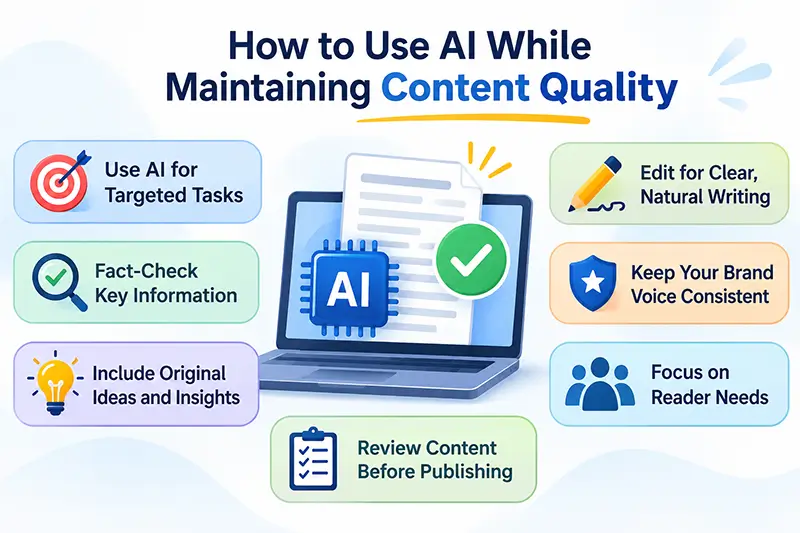
AI is a useful writing assistant when you apply it thoughtfully. The goal is not to avoid AI entirely but to prevent its limitations from affecting the final content. Follow these practices to maintain quality:
- Use AI for specific tasks: Apply it to brainstorming, outlining, summarizing source material, or identifying gaps in a draft.
- Verify important information: Check facts, statistics, technical details, and references against credible sources.
- Add original insights: Include expert perspectives, practical examples, firsthand experiences, and industry-specific knowledge.
- Edit for natural language: Remove repetitive phrases, generic introductions, unnecessary wording, and awkward transitions.
- Maintain brand consistency: Review tone, terminology, and messaging against established writing guidelines.
- Prioritize reader needs: Ensure every section answers a relevant question or provides useful information.
- Conduct a final review: Check accuracy, structure, readability, originality, and the overall purpose before publishing.
Frequently Asked Questions (FAQs)
How can AI hurt content writing?
AI may produce generic language, factual errors, repetitive ideas, and content that lacks originality, reducing reader trust and content quality.
Does AI-generated content affect SEO?
AI-generated content does not automatically harm SEO, but content that lacks originality, accuracy, and reader value may perform poorly in search results.
Why does AI-generated content lack originality?
AI tools rely on learned patterns, which may lead to familiar ideas and predictable phrasing without fresh perspectives or expert insights.
How can writers maintain content quality when using AI?
Writers should verify facts, add original examples, edit repetitive language, maintain brand voice, and ensure the content meets readers’ needs.
Can AI-generated content damage brand trust?
Yes. Inaccurate claims, generic writing, and a tone that does not match the brand may reduce credibility and reader confidence.
Conclusion
What are the negative effects of AI-generated content? Generic phrasing, factual errors, weak brand voice, and limited audience insight. Without proper review, these issues reduce content quality and reader trust. AI supports research, brainstorming, and drafting, but effective content writing requires independent thinking, fact-checking, and audience understanding. Businesses should treat AI output as a draft, not a finished product. Combine AI tools with human expertise and careful editing to develop accurate, distinctive, and relevant content.
Make AI-assisted content more distinctive, relevant, and trustworthy with professional editing and content writing support.