
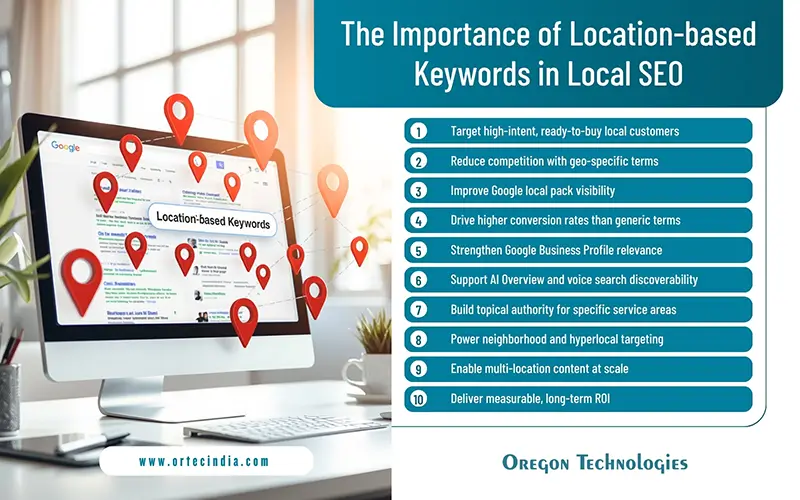
For any business that serves a defined geographic area, the digital visibility it earns in that territory is directly tied to its revenue potential. At the core of that visibility lies the strategic use of location-based keywords in local SEO, which are geo-specific terms that connect a business with nearby customers who are actively ready to buy. Understanding their role, selecting them with precision, and deploying them across digital assets is not optional. It is the foundation of a competitive local presence. Yet many businesses underestimate the depth of strategy involved, which is why investing in professional local SEO services has become a defining factor between businesses that dominate their local market and those that remain invisible in it.
Why Geographic Keyword Targeting Drives Local Conversions
Generic, non-geographic keywords target broad audiences and produce low conversion rates for businesses with a physical or region-specific footprint. Location-specific terms, in contrast, carry immediate purchase intent. A user searching for “emergency plumber in Austin” is far closer to a transaction than one searching for “plumbing tips.”
According to SEMrush’s Keyword Magic Tool data cited by SOCi, there are over 5.9 million keywords related to “near me” in the United States, generating 800 million searches per month. This volume reflects not passive browsing but active, location-driven intent. Businesses that embed geo-specific terms into their content intercept these users at the precise moment of decision.
The conversion outcomes reinforce this argument. Industry-aggregated data compiled by Marketing LTB indicates that conversion rates for local-intent keywords are commonly 15 to 30% higher than those for general search terms. That differential fundamentally changes the return on investment for every piece of content a business publishes.
Strengthen your local search presence with a precise, data-driven keyword strategy built for your market.
Types of Location-based Keywords in Local SEO
Not all geo-targeted terms function the same way. Businesses must understand the distinct categories to build a comprehensive targeting strategy:
- Explicit local keywords: These include a clear geographic reference such as “dental clinic in Boston,” “event planner in Chicago,” or “law firm in Houston.” They are direct and high-intent.
- Implicit local keywords: These carry geographic intent without naming a location, such as “pizza delivery near me,” “open dentist now,” or “emergency electrician.” Search engines infer the user’s location to serve relevant results.
- Neighborhood and landmark keywords: Terms that reference specific districts, neighborhoods, or landmarks, such as “coffee shop near Times Square” or “office space in Midtown Atlanta,” target hyperlocal audiences with precision.
- Service and city keywords: Combinations such as “digital marketing agency in Seattle” or “roofing contractor in Phoenix” are high-converting because they match both the service need and the geography simultaneously.
- Long-tail geographic keywords: Phrases like “affordable wedding photographer in South Austin” attract lower search volume but yield higher qualification rates because they capture specific, narrow intent.
A well-rounded keyword architecture incorporates all five categories to cover varying stages of the customer journey.
How to Find the Right Location-based Keywords: Tools and Techniques
Identifying the right geo-targeted terms requires more than intuition. Professional-grade tools provide the data layer necessary for informed decisions.
Google Keyword Planner remains a foundational resource. Marketers can filter keyword suggestions by geographic region, review monthly search volumes at the city or state level, and assess competition. For businesses entering new markets, it delivers a reliable starting point for understanding local search demand.
Semrush goes further with its Keyword Magic Tool, which generates thousands of keyword variations alongside intent signals, keyword difficulty scores, and SERP feature data. Its Position Tracking tool monitors how a domain performs for specific geo-targeted terms in particular cities or zip codes, giving businesses a continuous view of their local ranking performance.
Ahrefs excels in competitive analysis. Its Keywords Explorer maps out the geo-specific terms for which competitor websites rank, revealing gaps and opportunities. The Site Explorer feature identifies which location pages on rival domains attract the most organic traffic, providing a direct blueprint for content development.
Together, these platforms reduce guesswork and replace it with evidence-based targeting.
Keyword Comparison: Generic vs. Location-based Terms
The table below illustrates how geographic specificity changes keyword performance characteristics:
| Keyword Type | Example | Search Intent | Conversion Potential | Competition Level |
|---|---|---|---|---|
| Generic | web design services | Informational / Broad | Low | Very High |
| Generic + Modifier | affordable web design | Commercial | Moderate | High |
| City-Level | web design agency in Austin | Transactional | High | Moderate |
| Neighborhood-Level | web designers in SoHo New York | Transactional | Very High | Low |
| Near Me | web design near me | Transactional / Urgent | Very High | Low to Moderate |
The pattern is clear: narrowing geographic specificity raises purchase intent and reduces competitive pressure simultaneously, a combination that improves campaign efficiency at every level.
Strategic Deployment across Digital Assets
Identifying location-specific terms is only half the work. Their placement across a website and broader digital ecosystem determines whether they produce rankings and traffic.
Key deployment areas include:
- Page titles and H1 tags: The primary signal for search engines about page content. A title like “Top Accounting Services in Denver, CO” communicates both the service and the geography unambiguously.
- Meta descriptions: While not a direct ranking factor, meta descriptions influence click-through rates. Including a city or region name reinforces relevance for the searcher.
- URL structure: Clean, descriptive URLs such as /services/plumbing-dallas/ contribute to thematic and geographic clarity.
- Body content: Natural, contextual use of geographic terms throughout page copy strengthens topical relevance without triggering keyword-stuffing penalties.
- Google Business Profile: The description, service areas, posts, and categories should reflect the same geographic terms used in on-page content.
- Schema markup: Local Business schema provides structured data that explicitly communicates a business’s name, address, service area, and category to search engines, strengthening the signals that drive local search rankings and local pack visibility.
- Image alt text: Attaching geographic context to image descriptions, such as “storefront exterior, downtown Nashville branch,” adds incremental relevance signals.
Consistency across all these touchpoints, what practitioners call NAP (Name, Address, Phone) consistency, reinforces credibility with both search engines and prospective customers.
Real-world Example: 20/20 Institute, Denver, Colorado
20/20 Institute, a multi-location vision correction practice in Colorado, partnered with an SEO agency after its organic search results underperformed despite strong Map Pack visibility. The practice operated in a competitive medical market where paid ads for keywords like “LASIK Denver” cost more than $50 per click, making organic visibility a business-critical priority.
The agency built a targeted keyword strategy around high-intent, location-specific terms for each clinic location, developed geo-optimized content, and executed a comprehensive Google Business Profile overhaul. The strategy combined location page development with authoritative content creation to build geographic relevance and topical authority across Colorado’s major markets.
Within four to five months, 20/20 Institute reached the number one position in both the Google Map Pack and organic results for “LASIK Denver.” The practice reported a 20% increase in business and expanded its engagement with the agency. It subsequently appeared in Google AI Overviews for vision correction searches, reflecting how strong geo-targeted content now directly influences visibility in AI-generated results.
This case demonstrates a fundamental truth: precise geographic keyword strategy, executed with technical discipline, produces measurable business outcomes in competitive markets.
How AI Is Transforming Location-based Keyword Research and Deployment
Artificial intelligence has introduced a fundamental shift in how businesses approach geo-targeted content strategy. The transformation operates at multiple levels, from discovery and analysis to personalization and ranking.
AI-assisted keyword research platforms now process millions of queries, competitor signals, and user behavior patterns in real time, surfacing location-specific opportunities that manual research would miss. Semrush’s AI-powered analysis tools integrate keyword difficulty, intent classification, and geographic performance data into a single workflow, compressing what previously took days into hours.
AI-enabled content generation tools help businesses produce geo-specific landing pages and service-area content at scale, maintaining topical depth and geographic relevance without sacrificing quality. This capability is particularly valuable for multi-location businesses that must create distinct, non-duplicate content for each service area.
Beyond keyword research, AI-driven personalization is reshaping how results surface. Search engines now use machine learning to interpret user intent, location signals, and past interaction history when assembling results. A business’s content must be structured with clarity and precision to be understood and cited by these models.
The impact on consumer behavior is already measurable. According to SEOptimer’s research, 45% of consumers now use AI tools to discover local businesses, up sharply from just 6% the previous year. The same source notes that AI Overviews appear in up to 68% of local searches, meaning that content optimized purely for traditional blue-link results risks being bypassed entirely.
AI-powered competitive analysis tools identify hyperlocal keyword gaps by mapping what nearby competitors rank for and where their content underperforms. This gives businesses a data-backed roadmap for content investment rather than relying on assumptions.
For businesses working with a professional local SEO services provider, AI-assisted strategies now form the baseline expectation, not a premium add-on. The businesses that integrate this AI-driven approach into their geo-targeting strategy will hold a structural advantage in local discoverability.
Building a Durable Local Presence through Geographic Keyword Strategy
Sustained local visibility is not the result of a one-time optimization effort. It requires a living content strategy that reflects how local audiences search, what competitors are doing, and how platform algorithms evolve.
Businesses working with a qualified SEO services company gain access to ongoing keyword research, performance monitoring, and content architecture refinement, capabilities that compound in value over time. Location-specific content should be audited quarterly, new service-area pages developed as the business expands geographically, and keyword performance reviewed against business outcomes rather than traffic metrics alone.
Ultimately, the consistent and strategic use of location-based keywords in local SEO determines whether a business appears in front of high-intent local buyers or remains invisible in the moments that drive decisions. In a competitive digital environment, that distinction translates directly into market share.
Is your business missing from local search results?
We create geo-targeted keyword strategies that improve rankings and attract ready-to-buy customers.