Two years ago, most businesses had only one digital visibility goal: rank higher on search engines. That goal has not disappeared, but a second, equally important goal has emerged alongside it. Today, businesses also need to appear in AI-generated answers on platforms like ChatGPT, Perplexity, and Google’s AI Mode. This is the central tension in AI visibility vs SEO. Understanding how these two disciplines differ, overlap, and work together is now essential for any business that depends on being found online. Partnering with a reliable SEO services company that understands both is the clearest path forward.
What Actually Changed in Search
Search engines used to work in a straightforward way. A user typed in a short keyword. A list of ranked links appeared. The user clicked one.
That model still exists. But it no longer dominates.
AI platforms now synthesize answers from multiple sources. They present a single, structured response. They do not always show a list of links. In many cases, they do not show links at all.
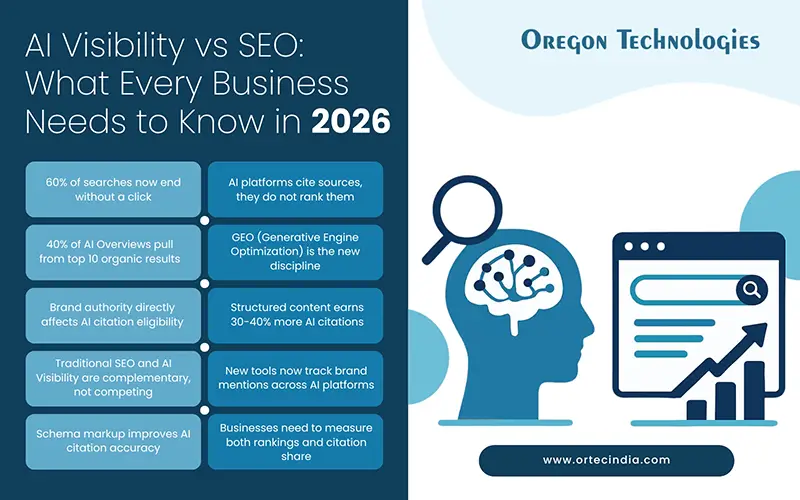
Traditional search volume was projected to drop 25% as users shift to AI-powered answer engines. According to Incremys’ 2026 GEO Statistics report, 60% of searches now end without a click. The click-through rate at position one has fallen to just 2.6% when an AI Overview is present.
These numbers represent a structural change. Ranking on page one is still valuable, but ranking alone no longer guarantees traffic. Businesses now need to think about two different types of presence: one in traditional search results, and one in AI-generated responses.
Build a digital presence that performs in both traditional search and AI-generated results.
AI Visibility vs SEO: What the Difference?
Understanding AI Visibility vs SEO starts with understanding what each discipline actually does.
Traditional SEO focuses on earning high positions in search engine results pages. It works through keyword research, technical site structure, backlink acquisition, and content quality signals. The measure of success is position and traffic.
AI visibility, also called Generative Engine Optimization (GEO), focuses on something different. It works to get a brand’s content cited, referenced, or recommended by AI systems when they generate answers. The measure of success is citation frequency, brand mention share, and how accurately AI platforms represent a business.
Both disciplines share common ground in some areas. Both:
- require high-quality content
- reward genuine expertise
- depend on technical structure and credibility signals
However, their goals, metrics, and tactics diverge in important ways.
A business that focuses only on traditional search faces the risk of becoming invisible on AI platforms. A business that focuses only on AI citation without strong search foundations loses the organic traffic that still drives the majority of clicks. A winning digital marketing strategy in 2026 accommodates both.
How AI Systems Decide What to Cite
Understanding how AI citation works helps businesses build content that earns it.
AI-powered platforms do not rank pages like search engines do. They analyze large volumes of content and identify sources that are authoritative, well-structured, and directly relevant to a query. Sources cited by trusted publications carry more weight. Content that answers questions directly and concisely is more likely to be extracted and referenced.
One study analyzed 10,000 real-world queries and found that pages with structured lists, quotes, and statistics had 30-40% higher visibility in AI responses. According to LLMrefs’ 2026 GEO guide, leading with direct answers at the start of each section significantly increases the likelihood of being extracted as a citation.
This has practical implications for content design. Short paragraphs perform better than long blocks of text. Clear, descriptive headers help AI systems categorize content. Factual claims backed by primary sources carry more weight than opinion. Structured data, such as FAQ Pages and Article schema, gives AI systems machine-readable signals about what a page contains.
For a deeper understanding of how one major AI search experience processes and cites content, the guide on Google AI Mode explained is a useful reference.
Where Traditional SEO Still Holds the Advantage
It would be a mistake to treat traditional search optimization as obsolete. The evidence does not support that conclusion.
Nearly 40% of AI Overviews pull from pages that rank in the top 10 organic results, and nearly 70% pull from pages in the top 100.
According to Jasper’s April 2026 GEO guide, strong organic positioning and AI citation are closely linked, not competing outcomes.
A page that ranks well because it is authoritative and well-structured is also more likely to be cited by AI systems. The two outcomes reinforce each other.
Backlinks, technical site health, and content depth remain important for both disciplines. What changes is the measurement framework and some tactical priorities.
For businesses looking to build an integrated approach, the resource on AI search optimization outlines how both can be aligned under a single strategy.
Key Differences in Measurement
One of the most significant practical differences between traditional search performance and AI presence lies in how each is measured.
Traditional search metrics are well established. Businesses track keyword positions, organic traffic volume, click-through rates, and conversion rates from search. These metrics have reliable tooling and years of benchmarking data.
AI presence metrics are newer and less standardized. Businesses need to track:
- Brand mention frequency: How often does an AI platform reference the business by name?
- Citation share: When an AI answers a question in the business’s category, is it cited as a source?
- Sentiment accuracy: Does the AI represent the business correctly and positively?
- Competitive positioning: Which competitors are being cited instead, and for which queries?
Tools like Semrush’s Enterprise AIO, Otterly.AI, and Profound now track these metrics across platforms including ChatGPT, Perplexity, and Google’s AI Mode. This category of tooling did not exist two years ago. It is now a standard part of a complete digital visibility strategy.
How AI Is Transforming the Optimization Process
AI is not just the new channel to optimize for. It is also transforming how optimization work gets done.
AI-assisted keyword research now surfaces the exact questions that users ask these platforms, not just what they type into search engines. Such queries tend to be longer, more specific, and more conversational.
AI-enabled content analysis tools evaluate pages against citation-readiness signals. They identify structural weaknesses and gaps in topical coverage before these issues affect performance.
AI-powered competitive analysis maps which sources these platforms cite for any given query category. This reveals which competitors have earned strong presence and what content strategies they used.
AI-driven brand monitoring tracks how these platforms describe and represent a business over time. If a platform describes a business inaccurately, or not mentioning it at all, these tools surface that gap.
Together, these tools make the optimization process faster and more precise. Businesses that use them gain clearer insight into where to invest and what outcomes to expect.
For a broader view of the trends shaping digital search in 2026, the guide on mastering SEO in 2026 outlines the full strategic landscape.
Practical Priorities for Businesses in 2026
Businesses that want to build presence across both traditional and AI search surfaces should focus on the following:
- Invest in content depth: Shallow pages with limited factual content perform poorly in both environments. Comprehensive coverage of a topic, backed by real data and primary sources, earns both rankings and citations.
- Structure content for extraction: Use clear headers, short paragraphs, and direct answers at the start of each section. This helps both search engines and AI systems process and use the content.
- Implement schema markup: FAQPage, Article, and LocalBusiness schema give AI systems the machine-readable signals they need to categorize and cite content accurately.
- Build brand authority off-site: AI systems favor brands that are mentioned and cited across trusted third-party publications. PR, thought leadership, and industry partnerships contribute directly to AI citation eligibility.
- Monitor AI presence regularly: Track how AI platforms reference the business, what they say, and which competitors appear in its place. Treat this as a standard reporting metric alongside traditional search data.
- Maintain technical foundations: Page speed, mobile performance, and clean site architecture remain essential. These signals affect both traditional performance and AI citation eligibility.
Businesses that invest in professional search engine optimization services built for this dual-channel environment gain structured oversight across both disciplines.
AI Visibility vs SEO: A Side-by-Side Comparison
| Dimension | Traditional SEO | AI Visibility (GEO) |
| Primary goal | Earn high search positions | Earn citation in AI-generated answers |
| Success metric | Rankings and organic traffic | Citation frequency and brand mention share |
| Key signals | Keywords, backlinks, technical structure | Authority, content structure, E-E-A-T, schema |
| Measurement tools | Search Console, Semrush, Ahrefs | Semrush AIO, Otterly.AI, Profound |
| Content format | Keyword-optimized pages | Direct-answer, structured, citation-ready content |
| Brand dependency | Lower | Higher |
| Obsolete in 2026? | No | N/A (emerging discipline) |
The table above shows that these are complementary disciplines, not competing ones. A business that excels at both holds a structural advantage over competitors that focus on only one.
Building Dual-Channel Visibility Strategy
The central lesson of AI Visibility vs SEO in 2026 is straightforward. Neither discipline alone is sufficient. Traditional search still drives significant click-based traffic, and organic positions remain closely linked to AI citation eligibility. At the same time, a growing share of consumer discovery now happens inside AI-generated responses where traditional rankings carry no direct weight. Investing in search engine optimization services designed for this dual-channel reality positions a business to compete across both surfaces effectively.
The organizations that will lead their categories in the years ahead are those that treat both AI and SEO as essential, build content that serves both audiences, and monitor performance across both channels consistently. Optimizing for both is an accurate response to how search actually works today.
Is your business invisible in AI-generated answers?
Our team builds content and visibility strategies that work across both search engines and AI platforms.