To remain competitive, every website needs a steady stream of high-authority links pointing to it. Guest blogging for backlinks is one of the most effective and editorially respected methods to earn those links. Unlike paid placements or directory submissions, this approach builds credibility alongside visibility. A well-planned guest post strategy, can position a brand as a thought leader while simultaneously strengthening its search presence. This blog breaks down the mechanics, strategy, and modern tools that make the practice worth investing in.
What Makes Guest Blogging a Credible Link-Building Method
Not all backlinks carry equal weight. Search engines evaluate the authority, relevance, and editorial context of a linking page before assigning value to the link it contains. Guest blogging for backlinks earn reputation because it places links inside original, contextually relevant editorial content on established third-party websites.
This matters for several reasons:
- Editorial placement: The link appears within body content, not a sidebar or footer, which signals higher relevance.
- Topical alignment: A well-placed guest post on a niche-relevant site tells search engines that the linked site belongs to that subject area.
- Authority transfer: When a high-domain-authority site links to a target page, it passes measurable link equity.
- Referral traffic: Beyond rankings, guest posts bring direct readers who already have an interest in the topic.
SEO link building experts consistently rank guest posting among the highest-value strategies in their toolkit.
Discover how guest blogging for backlinks can build authority and support stronger search rankings.
Building a Guest Post Strategy That Generates Real Results
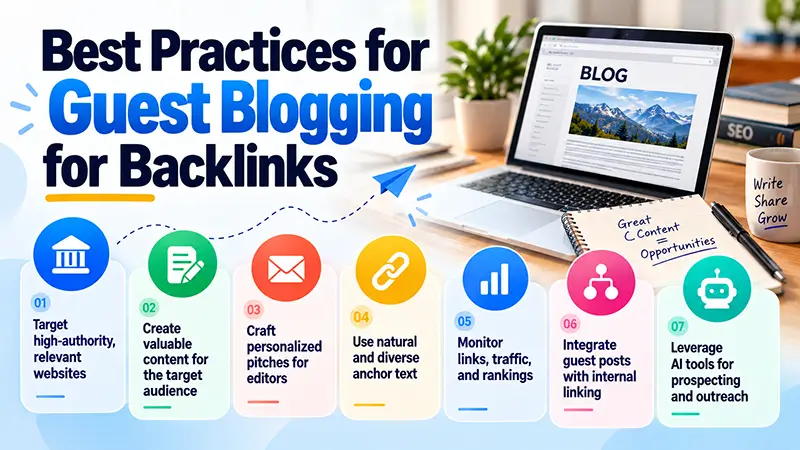
Executing this tactic without a plan produces inconsistent results. A sound guest post strategy begins with prospecting and ends with performance tracking. Here is how to build one that delivers:
Step 1: Prospect for High-Quality Sites
Target websites that meet the following criteria:
- Strong domain authority (verified through tools such as Ahrefs, Moz, or Semrush)
- Active editorial standards and a clear content review process
- Topical relevance to the target brand’s industry
- Genuine audience engagement, reflected in comments and social shares
Avoid sites that clearly accept any submission without editorial scrutiny. These links provide diminishing returns and can introduce risk.
Step 2: Craft Pitches That Editors Accept
A generic pitch fails immediately. Research the publication’s existing content, identify a gap, and propose a topic that fills it. Keep the pitch brief, demonstrate subject-matter expertise, and include two or three relevant writing samples. Editors receive dozens of pitches weekly; specificity and professionalism separate successful submissions from deleted ones.
Step 3: Write Content That Earns the Link Naturally
The goal is to produce an article the host site’s audience finds genuinely useful. The link back to the target site should appear naturally within the body, anchored with descriptive text that reflects the linked page’s content. Forced or over-optimized anchor text raises red flags for both editors and search engine algorithms.
Step 4: Monitor and Measure
After publication, track the indexed link, the referral traffic it generates, and any movement in the target page’s ranking for relevant terms. This data informs which publications deliver the strongest returns and where to focus future outreach.
How to Select the Right Publications
Publication selection is where many campaigns fail. The instinct to target only the highest-authority domains leads teams to ignore mid-tier publications that convert exceptionally well. A diversified approach works best.
Consider these factors when shortlisting publications:
- Audience fit: Does the publication’s readership include potential customers or industry peers?
- Content format: Does the site publish long-form, research-backed articles, or brief opinion pieces? The format must match the target brand’s content style.
- Link profile: Does the publication link out naturally within its editorial content, or does it aggressively nofollow all outbound links?
- Publication frequency: Active sites with frequent publishing schedules tend to get indexed faster and retain higher crawl priority.
For businesses offering professional SEO services, maintaining a curated, continuously updated list of target publications is a core operational practice, not a one-time exercise.
How AI Is Transforming Guest Post Outreach and Content Development
AI-powered tools have reshaped how digital marketers approach guest posting for SEO. What was once a manually intensive, time-consuming process now benefits from intelligent automation at multiple stages.
AI-driven prospecting tools scan the web for publications that match a brand’s niche, authority thresholds, and audience demographics. They surface relevant opportunities at a scale that manual research cannot match.
AI-assisted pitch writing helps marketers craft outreach emails tailored to each editor’s known preferences, the publication’s editorial tone, and recent content themes. This raises pitch acceptance rates without sacrificing personalization.
AI-enabled content drafting accelerates the writing process by generating structured outlines, identifying topical gaps, and suggesting supporting arguments. Writers then refine this foundation into publication-ready articles. The result is faster turnaround without a drop in quality.
Beyond content creation, AI tools now assist with AI search optimization, ensuring that guest posts are structured to perform not just in traditional search results but also in AI-generated answer engines and featured snippet placements. As search behavior continues to evolve, this dual-optimization approach is becoming a standard part of competitive content strategies.
Anchor Text Optimization: A Key Element That Determines Link Value
A published guest post only delivers its full value when the anchor text is correctly optimized. Many practitioners get this wrong, either by over-optimizing with exact-match keyword anchors or by using vague phrases that provide no relevance signal.
Best practice calls for a varied anchor text profile that includes:
- Exact match anchors: Used sparingly for the primary target keyword
- Partial match anchors: Include one or two words from the target keyword phrase
- Branded anchors: The company or product name as anchor text
- Natural phrase anchors: Descriptive phrases that reflect the linked page’s content without keyword stuffing
This variation mirrors organic linking behavior, which search algorithms reward. Consistent over-reliance on a single anchor text pattern, particularly an exact-match one, signals manipulation and can suppress ranking gains.
Connecting Guest Posts to the Broader SEO Architecture
Guest posts function best when they are part of a cohesive site structure. A backlink pointing to a well-structured internal page amplifies its value across the entire domain. For this reason, the landing pages that receive guest post links should be part of a deliberate internal linking strategy that distributes link equity to supporting pages.
This interconnected approach ensures that the authority earned from external publications flows efficiently through the site. Without it, even strong backlinks produce isolated gains rather than compounding improvements across the domain.
Why Guest Blogging remains Relevant in the Evolving Search Landscape
Search algorithms have grown more sophisticated, but the underlying principle they follow remains constant: editorial endorsement signals trust. A credible third-party site choosing to publish a brand’s content and link to its pages represents exactly that kind of endorsement.
Practices such as private blog networks, link exchanges, and automated link schemes have faced repeated algorithmic penalties. Guest blogging for backlinks, when executed with genuine editorial value, consistently survives these updates because it aligns with what search engines aim to reward: expert content written for real audiences.
Building the Link Profile Your Rankings Require
Guest blogging for backlinks is not a shortcut. It is a disciplined, editorial-first practice that builds link authority over time. Brands that invest in a well-researched guest post strategy, prioritize topical relevance, apply AI-powered tools to scale their outreach, and integrate external links into a structured site architecture earn ranking improvements that compound over months and years. This is how sustainable search visibility is built. Not through volume, but through value.
FAQs
How long does it take to see results from guest blogging for backlinks?
Results vary based on the authority of the publishing site, the competitiveness of the target keyword, and how frequently search engines crawl and index new links. Most practitioners observe measurable movement in rankings and referral traffic within a few months of consistent outreach.
How many guest posts are needed to make an impact?
There is no fixed number. What matters is the quality, relevance, and authority of the sites that publish the content. A few posts on high-authority, topically relevant sites outperform a large volume of posts on low-quality publications.
Should the anchor text always match the target keyword?
No. A natural anchor text profile includes a mix of exact-match, partial-match, branded, and descriptive anchors. Relying exclusively on exact-match anchor text can signal manipulation to search algorithms.
Can guest posting on low-authority sites cause harm?
Occasionally, yes. Links from sites with thin content, excessive outbound links, or clear link-scheme patterns can introduce risk. Vetting each target publication before submission is essential.
How does AI help with guest post outreach?
AI-driven tools assist with prospect identification, pitch personalization, content drafting, and performance analysis. They reduce the manual effort required at each stage without eliminating the need for human editorial judgment.
Need a strategic approach to building high-quality links?