
The way consumers find local businesses has changed fundamentally. Typing a query into a browser is no longer the default behavior for millions of individuals. Instead, they speak their questions aloud to Siri, Google Assistant, or Alexa while driving, cooking, or walking. For local businesses, this behavioral shift carries significant commercial consequences. Implementing deliberate voice search optimization is no longer a forward-looking initiative. It is a present-day competitive necessity. Yet most businesses still build their digital strategies around typed queries alone, leaving an expanding channel largely uncaptured. Partnering with a knowledgeable digital marketing agency that understands the distinct mechanics of spoken queries bridges that gap decisively.
The Scale of the Opportunity: Why Local Businesses Cannot Ignore Spoken Queries
The numbers make the case without ambiguity. According to data compiled by Invoca, 76% of smart speaker users perform local searches by voice at least once a week, and 46% do so daily. These are not passive browsers. They are consumers with immediate intent, searching for businesses, services, and locations in real time.
The commercial stakes are equally clear. According to Marketing LTB, 50% of local businesses already receive customers through voice search discovery, and voice commerce is projected to hit $80 billion by 2026. For any business that depends on foot traffic, phone inquiries, or local service calls, these figures represent a tangible and measurable revenue channel.
The profile of a voice searcher also differs from a typed-query user in one critical way: proximity and urgency. Someone asking their phone “Where is the nearest HVAC repair service open right now?” is not researching options. They are ready to call. Businesses that appear in the result for that query win the customer. Those that do not, lose them to a competitor who optimized for exactly that moment.
Position your business as the top answer when local customers ask their devices for a recommendation.
Connect with our experts today
How Spoken Queries Differ From Typed Searches
Understanding the structural difference between spoken and typed queries is the prerequisite for any effective strategy in this space.
Typed queries tend to be fragmented and keyword-based: “dentist Austin TX” or “coffee shop downtown.” Spoken queries are conversational, complete, and question-driven: “Which dentist near me accepts Blue Cross Blue Shield and has availability this week?” or “What coffee shop in downtown Austin is open right now?”
This distinction has three direct implications for content strategy:
- Query length: Spoken queries average significantly more words than typed ones, which means content must address full questions rather than isolated keywords.
- Interrogative structure: Spoken queries predominantly begin with who, what, where, when, why, and how. Content structured around these question formats performs disproportionately well in voice results.
- Local and transactional intent: The majority of spoken queries carry local intent. Phrases like “near me,” “open now,” “closest,” and “available today” appear far more frequently in spoken queries than in typed ones, making local relevance signals more important than ever.
Businesses that build content architecture around these patterns capture queries that their competitors’ keyword-focused pages are structurally incapable of addressing.
Voice Search Optimization: Core Technical and On-Page Strategies
Voice search optimization for local businesses operates across multiple layers, from technical infrastructure to content design. Each layer reinforces the others.
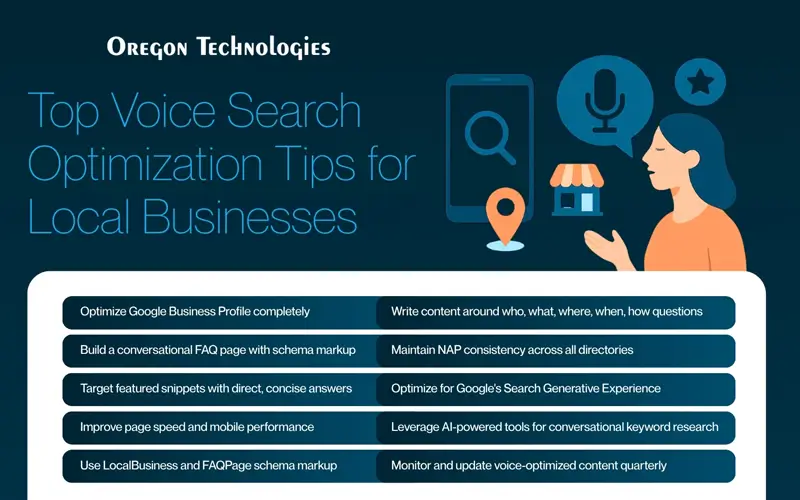
Page speed and mobile performance: Voice queries are executed overwhelmingly on mobile devices and smart speakers, and results are drawn from pages that load quickly and render cleanly on small screens. Google’s Core Web Vitals remain a foundational signal. A page that fails on mobile performance does not compete for voice-driven results regardless of content quality.
Conversational FAQ content: The most direct path to capturing spoken queries is a well-structured FAQ section that mirrors the exact questions consumers ask. Questions like “How much does a furnace tune-up cost in Chicago?” or “Is your restaurant open on Sundays?” map directly to the spoken queries that pull in high-intent, ready-to-act customers. Each question-and-answer pair should be concise, direct, and written in natural language.
Featured snippet targeting: Voice assistants read a single result aloud, typically the featured snippet that appears at the top of a search result page. Structured content that provides a direct, authoritative answer in the first two to three sentences of a response has the highest probability of being selected. The goal is to be the one answer, not one of ten blue links.
Schema markup: Structured data communicates explicit information to search engines about a business’s name, address, phone number, hours of operation, service types, and geographic area. Local Business schema and FAQ Page schema are particularly valuable for voice query performance, as they give search engines the precise, machine-readable signals needed to surface a business in response to spoken requests.
Google Business Profile completeness: Voice assistants, particularly Google Assistant and Siri, pull local business answers directly from Google Business Profile and Apple Maps respectively. A complete, accurate, and regularly updated profile, including hours, services, photos, and a keyword-informed description, is the single most direct technical lever for local voice query performance.
Google’s Search Generative Experience and Its Impact on Spoken Query Strategy
Google’s Search Generative Experience (SGE) has introduced a new layer of complexity and opportunity for businesses building strategies around conversational queries. SGE generates AI-synthesized answers at the top of search results, drawing from multiple sources to construct a single, authoritative response rather than presenting a ranked list of links.
For neighborhood-level businesses, this shift reinforces the same strategic principles that drive voice query performance: structured content, direct answers, accurate local data, and authoritative sourcing. Businesses whose content is formatted as clear questions and answers, supported by schema markup and consistent NAP data, are more likely to be cited as sources in SGE-generated responses.
The convergence of SGE and this behavior is particularly significant. As AI-generated answers become the default response format for complex local queries, the businesses best positioned are those that have already built their content around the conversational, question-and-answer structures that both SGE and voice assistants prefer. Investing in search engine optimization services that account for this convergence, rather than treating typed and spoken queries as separate disciplines, produces content assets that perform across both surfaces simultaneously.
How AI Is Reshaping the Spoken Query Landscape
Artificial intelligence has transformed both the supply side and the demand side of voice query performance. On the demand side, AI-powered voice assistants have become dramatically more accurate, more contextually aware, and more deeply integrated into daily routines. On the supply side, AI-driven tools are reshaping how businesses identify, target, and optimize for conversational query opportunities.
AI-assisted keyword research platforms now identify conversational query patterns at the local level, surfacing the exact questions consumers in a specific zip code or city are asking their devices. This level of granularity was inaccessible to manual research methods.
AI-enabled content tools help businesses generate FAQ pages, location-specific Q&A content, and structured schema at a scale that would otherwise require substantial editorial resources. For multi-location businesses that must create distinct, non-duplicate content for each service area, this capability is operationally transformative.
AI-driven competitive analysis identifies which voice query positions competitors currently own, what content structures they used to earn those positions, and where the uncontested opportunities exist. This produces a precise roadmap for content investment rather than a general content brief.
Perhaps most significantly, AI-powered natural language processing has made voice assistants genuinely conversational. They interpret intent, context, and follow-up questions rather than matching keywords. This means businesses must optimize for what a customer means, not just the words they use, a distinction that requires content strategy to evolve from keyword placement to genuine question-answering authority.
Real-World Example: D&F Plumbing, Portland, Oregon
D&F Plumbing, a long-established plumbing contractor serving the Portland, Oregon metro area, implemented a comprehensive local SEO strategy to strengthen its visibility in a highly competitive regional market. The initiative focused on geo-targeted content optimization, Google Business Profile management, and advanced schema markup, including FAQPage schema designed around the conversational, question-based queries customers use when searching for plumbing services.
The strategy also incorporated GPS SEO techniques to target users within D&F Plumbing’s specific service area, ensuring content and local profile signals aligned with the hyperlocal intent behind mobile and voice searches. Organic content development was paired with ongoing local search optimization efforts to improve visibility across both traditional and conversational search experiences.
The results were significant and sustained. Following the implementation of schema markup and localized content enhancements, D&F Plumbing reported a 112% increase in relevant traffic from the Portland metro area. The company also experienced an average annual increase in call volume of 149% since 2019, demonstrating the long-term impact of aligning technical SEO and content strategies with local customer search behavior.
Building a Durable Spoken Query Strategy for Local Businesses
Spoken query performance is not a one-time technical fix. It demands the same ongoing commitment as any other channel in a local digital strategy. Query patterns shift as consumer behavior evolves. Google Business Profiles require regular updates. FAQ content must reflect current pricing, hours, and service availability. Schema markup must be maintained as site architecture changes. Businesses that invest in ongoing search engine optimization services gain the structured oversight needed to keep every one of these elements current, accurate, and competitive.
Operators that treat voice query performance as a living discipline, auditing their FAQ content quarterly, monitoring their Google Business Profile weekly, and tracking their featured snippet performance consistently, build compounding advantages over competitors who treat it as a checkbox exercise.
Ultimately, a disciplined and sustained approach to voice search optimization determines whether a local business captures the high-intent, ready-to-act customer who asks their device for a recommendation, or watches that customer walk through a competitor’s door instead.
Is your business invisible in spoken search results?
Our team builds voice-optimized content strategies that improve local search rankings and convert spoken queries into paying customers.