A well-structured website is one that guides visitors smoothly to the information they need while helping search engines understand and rank its content well. Effective internal linking for SEO is a key component of logical content organization. How pages connect with each other carries more weight than most site owners recognize. Search engines use these connections to discover content, assign authority, and determine which pages deserve prominent placement in results. Users, meanwhile, rely on them to navigate deeper into a site.
When both needs are met through deliberate link placement, rankings improve and engagement increases. Internal link building plays a key role in applying these principles. This blog outlines five high-impact approaches to strengthen site architecture and drive organic growth.
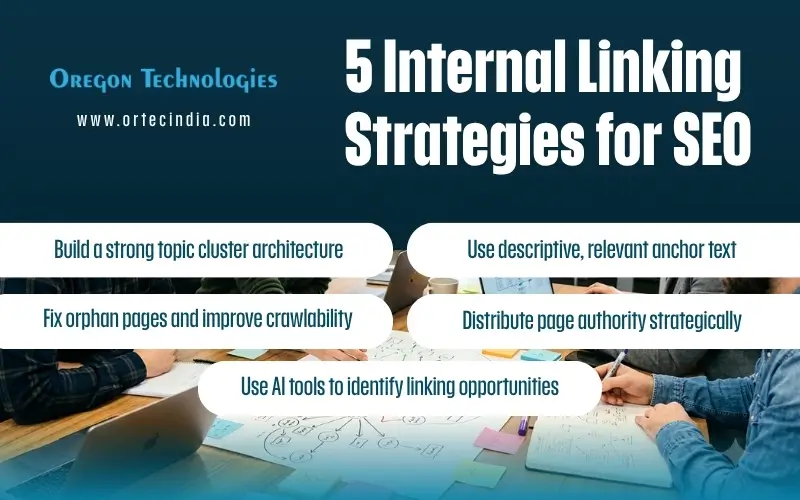
Build a Topic Cluster Architecture as Your Core Internal Linking Strategy
Topic clusters are the foundation of any sophisticated site structure. A pillar page covers a broad subject comprehensively, while cluster pages address specific subtopics in depth. Each cluster page connects back to the pillar page, and the pillar page references each cluster page. This creates a clear web of thematic relevance that search engines can interpret.
Example: A digital marketing agency might build a pillar page on “content marketing” and cluster pages on blog writing, video marketing, email newsletters, and content distribution. Each cluster page targets a specific long-tail query. All pages link to the pillar, and the pillar links out to all cluster pages.
The pillar-cluster model signals topical authority to crawlers. It tells search engines that a site covers a subject thoroughly, not superficially. This depth of coverage is increasingly rewarded in modern ranking systems.
For agencies delivering professional SEO services, building topic clusters is one of the first structural recommendations made during an audit. Sites that lack this architecture frequently have scattered link equity and underperforming content.
A weak site structure can limit rankings. Build stronger authority flow with a strategic internal linking audit.
Fix Orphan Pages and Prioritize Crawl Budget
Search engine crawlers find pages by following links. An orphan page is a page that no other page on the site connects to. If a page has no incoming connections, it may never be crawled or indexed, regardless of how good the content is.
Example: An e-commerce site with 500 product pages may have dozens of pages that were added during a website migration but never linked from any category or related product page. These pages sit invisible in the site architecture. A crawl audit would surface them.
For large sites with thousands of pages, crawl budget matters enormously. Search engines allocate a finite number of crawl requests to each domain. Poorly connected pages waste that budget. Resolving orphan pages through targeted link placement redirects crawler attention to high-value content that deserves ranking.
Tools such as the following help surface pages with zero incoming connections:
- Screaming Frog
- Ahrefs
- Google Search Console
Once identified, these pages should be linked from contextually relevant content, category pages, or the sitemap. Restoring each connection returns a page to active crawl circulation.
Use Descriptive Anchor Text across All Site Connections
Anchor text is not just navigational text. It is a ranking signal. Search engines read anchor text to understand the topic of the page being linked to. Generic phrases such as “click here” or “read more” provide no topical context. Descriptive, keyword-relevant phrases do.
Example: A healthcare website linking to a page about knee pain treatment should use anchor text such as “non-surgical knee pain treatment options” rather than “learn more.” The former tells the crawler exactly what the destination page covers.
On analyzing large volumes of internal links, studies have consistently found that pages using exact-match or descriptive anchor text attract meaningfully more organic traffic than those using vague, generic phrases.
However, over-optimization is a real risk. Using the exact same anchor text repeatedly across an entire site can trigger algorithmic penalties. The recommended approach is to vary anchor text naturally. Use the target keyword, close variations, and partial matches across different linking instances on the same page.
Effective anchor text strategy follows these principles:
- Vary phrasing across instances: Use the target keyword, semantic variations, and partial matches rather than repeating identical text.
- Reflect destination content: Anchor text should accurately describe what the reader will find on the linked page.
- Avoid keyword stuffing: Overuse of exact-match anchors raises algorithmic red flags and undermines link value.
Thoughtful anchor text selection is one area where internal link building delivers compounding returns. Every page added to a site is another opportunity to reinforce the relevance of existing content through precise, descriptive links.
Distribute Page Authority Strategically through High-Value Pages
Not all pages on a site carry equal authority. A homepage, a well-linked blog post, or a high-traffic resource page holds more accumulated authority than a newly published article. Distributing that authority through deliberate connections to important but under-linked pages is one of the most impactful structural decisions an SEO team can make.
Example: A SaaS company with a high-authority “Ultimate Guide to Project Management” post can connect it to a conversion-focused pricing page or a feature comparison page. This passes authority from a strong content asset to a page that drives direct revenue.
The concept of link equity flow requires mapping which pages hold authority and which pages need it most. Service pages, product pages, and conversion-focused landing pages are the highest priority targets. They convert visitors, but rarely attract natural connections the way informational content does. Deliberate editorial connections bridge that gap.
This approach requires a documented understanding of site hierarchy. The homepage holds the most authority. Pages connected directly hold the next tier. Pages buried under multiple clicks receive considerably less crawl attention.
How AI-Assisted Tools Are Transforming Internal Linking for SEO
Manual link management does not scale. A site with hundreds of pages and steady content publication needs a systematic approach to identifying connection opportunities. AI-driven tooling is transforming that process.
AI-powered platforms such as Link Whisper, SEOJuice, Search Atlas OTTO, and JetOctopus Linker analyze entire websites and surface relevant linking opportunities. They assess semantic relationships between pages, identify orphan pages, and recommend anchor text variations. Select platforms place links automatically upon content publication.
JetOctopus Linker applies AI to classify page attributes and produce matches between donor and acceptor pages. This enables true semantic linking, where pages are connected based on content proximity rather than surface-level keyword matching. It helps crawlers understand the site’s structure and improves crawl budget efficiency.
AI-enabled analysis also improves audit speed and accuracy. Rather than manually reviewing thousands of pages, SEO teams receive prioritized recommendations they can act on immediately. This shifts human effort from discovery to decision-making.
AI-powered tools like SEOJuice automate a large portion of on-page technical optimization, including internal link placement, without modifying published content.
AI-assisted site architecture carries implications beyond traditional search. Understanding how AI citation in platforms like Perplexity and ChatGPT works is increasingly important for content teams. A site with a coherent, well-connected structure are more likely to be recognized as an authoritative source. Teams building a comprehensive visibility strategy should explore AI search optimization as a complementary discipline.
FAQs
How many internal links should a page have?
There is no fixed rule, but quality and relevance matter more than quantity. Each link should serve a clear navigational or topical purpose. Avoid adding connections purely to inflate numbers, as this can dilute the value passed to each linked page.
Should internal links open in a new tab?
No. Internal connections should open in the same tab. New tab behavior is typically reserved for external links. Keeping users within the same browsing session maintains continuity and reduces friction.
Does connecting to a page multiple times from the same article help?
Only the first instance of a link on a given page typically passes authority. Subsequent links to the same destination add minimal SEO value. Use the first occurrence for the most relevant anchor text.
How do I find pages that need more internal connections?
Tools such as Ahrefs Site Audit, Screaming Frog, and Google Search Console can identify pages with few or no incoming connections. Filter for pages with zero referring internal URLs and prioritize them based on their business value.
Do navigation menus count as internal links?
Yes, but they carry less contextual weight than in-content connections. Navigation menus link to the same pages across every page of the site. In-content links are more valuable because they appear within relevant editorial context and carry specific anchor text.
Build Rankings on a Foundation That Search Engines Can Follow
A site’s architecture is a direct reflection of how well its team understands search behavior. Internal linking for SEO is not a technical checkbox. It is an ongoing discipline that shapes crawlability, authority distribution, topical relevance, and user experience simultaneously.
The five approaches covered here work together to create a strong internal linking strategy that builds a site structure capable of earning and sustaining rankings. Organizations serious about organic growth treat these practices as core to their operations, not as afterthoughts applied once and forgotten.
Losing valuable link equity?
Find orphan pages and strengthen internal links for better site connectivity.