Search has changed faster in the past two years than in the previous decade. AI-generated answers now sit above traditional results. Many searches end without a single click. For businesses, this shift changes everything. Mastering SEO in 2026 means understanding these new rules and acting on them early. It also means letting go of old habits that no longer work. Businesses that invest in modern search engine optimization services are better placed to adapt quickly. This guide breaks down the most important trends shaping search this year. Each section explains what is changing and what businesses should do about it.
Why 2026 Marks a Turning Point for Search
The numbers tell a clear story. According to Goodfirms’ 2026 survey of digital marketing practitioners, nearly 60% of Google searches now end without a click. AI Overviews appear in 89% of brand-related searches.
This is not a small shift. Visibility and traffic are no longer the same thing. A business can appear in a search result and still receive zero visitors.
The same survey found that 65% of marketers see AI-driven search changes as their biggest challenge this year. Many businesses feel unsure how to adapt.
The good news is that the fundamentals still matter. Quality content, technical structure, and genuine expertise remain the foundation. What has changed is how these get used and measured.
Stay ahead of every major search update with a strategy built for 2026 and beyond.
Trend One: AI-First Search Becomes the Default
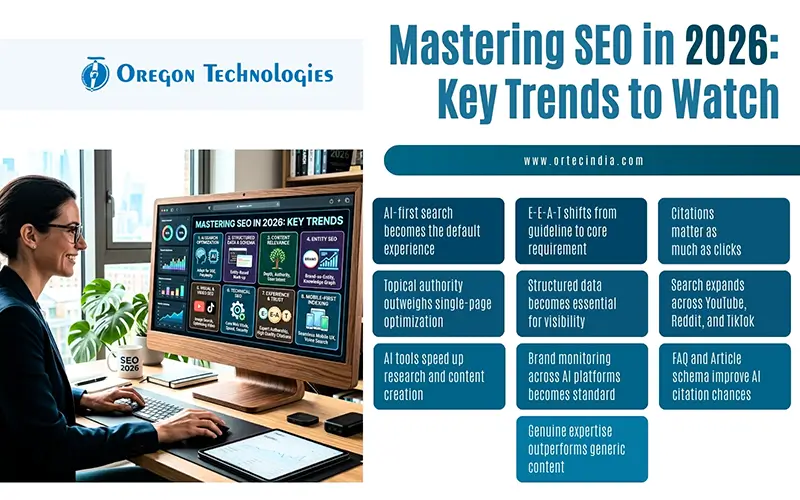
AI Overviews and AI Mode are no longer experiments. They are core parts of how people search. Users increasingly ask full questions instead of short keyword phrases.
For example, a user might once have typed “best CRM software.” Now they ask, “What CRM works best for a small sales team that is scaling fast?”
Content written in a natural, conversational style performs better here. Direct answers placed early in a page help AI systems extract information. Specific, descriptive headers also help readers and AI systems understand what a page covers.
Businesses should review existing content with this lens. Pages that answer real questions, in plain language, are more likely to get cited. The guide on AI search optimization explores this shift further.
Trend Two: E-E-A-T Becomes a Core Requirement, Not a Guideline
E-E-A-T stands for Experience, Expertise, Authoritativeness, and Trustworthiness. It has existed as a quality guideline for years. In 2026, it works more like a filter AI systems use to decide what to trust.
Generic, surface-level content now struggles to compete. Content backed by real experience performs better.
Practical steps businesses can take include:
- Adding author bios with relevant credentials and experience
- Citing primary sources and original research where possible
- Displaying genuine customer reviews and testimonials
- Seeking mentions in respected industry publications
- Updating older content to reflect current information and data
These steps build trust signals that both readers and AI systems can recognize. Trust is no longer optional. It is a baseline requirement for visibility.
Trend Three: Citation Replaces Clicks as the New Success Metric
The shift from clicks to citations is one of the most important changes in 2026. When AI systems answer a question directly, they often cite one or more sources. Being cited carries value, even without a click.
According to DigitalApplied’s 2026 zero-click data update, AI Overview coverage climbed from roughly 30% in December 2025 to nearly 48% by March 2026. At the same time, branded queries that include a clear source link saw an 18% increase in click-through rates.
This tells an important story. Generic informational content is losing visibility fast. But strong brand presence, paired with clear sourcing, can still drive results. Businesses need to think beyond raw traffic numbers. Being recognized as a trusted source, even within an AI-generated answer, builds long-term brand value.
This is why many businesses now track brand mentions across AI platforms. Monitoring how tools like ChatGPT, Perplexity, and Google’s AI Mode reference a brand has become a standard practice. For a closer look at how one major AI search experience works, the guide on Google AI Mode explained covers the topic in detail.
Trend Four: Topical Authority Outweighs Individual Page Optimization
In 2026, search systems care less about single pages. They care more about whether a website demonstrates deep knowledge of a subject. This is called topical authority.
Building topical authority means covering a subject thoroughly. Related pages should connect through clear internal links. Shallow, one-off blog posts that do not build on each other should be avoided.
A useful approach is to create topic clusters. A topic cluster includes one central, comprehensive page. Several supporting pages then explore related subtopics in depth. Each supporting page links back to the main page and to each other where relevant.
This structure helps in two ways. It helps human readers find related information easily. It also helps AI systems understand the full scope of a website’s expertise on a topic.
Trend Five: Structured Data Becomes Essential, Not Optional
Structured data, also known as schema markup, has existed for years. In 2026, it plays a bigger role. It acts like a label that tells AI systems what a page is about.
Common types of structured data include:
- FAQ schema: Marks up question-and-answer content clearly
- Article schema: Identifies blog posts and news content
- LocalBusiness schema: Provides business name, address, and contact details
- Review schema: Displays star ratings and customer feedback
- HowTo schema: Structures step-by-step instructions
Nested schema is also becoming common. This means placing one schema type inside another, such as Review schema inside Product schema. This gives systems a richer picture of a page.
Businesses that implement structured data correctly gain a clear advantage. Their content becomes easier for AI systems to understand.
Trend Six: Search Happens Everywhere, Not Just on Google
Search is no longer limited to one platform. People now search on YouTube, TikTok, Reddit, and Instagram, alongside traditional search engines. This is often called “search everywhere optimization.”
According to Circles Studio’s 2026 SEO trends report, Google Search still holds the largest share of digital queries at 77.9%. ChatGPT now accounts for 17.1% of queries. The remaining share is split across other platforms.
This data shows two things clearly. Google remains the dominant search platform. At the same time, AI chat platforms have become a meaningful part of how people find information.
Businesses should think about visibility across multiple platforms, not just one. A short product video can perform well on YouTube. Helpful discussion posts can build authority on Reddit. Each platform reaches a different audience segment.
How AI Is Transforming the Optimization Process Itself
AI is not just changing how people search. It is also changing how businesses do this work. The shift affects research, content creation, and performance tracking.
AI-assisted research tools now scan thousands of pages quickly. They identify content gaps and missing topics. This work once took days. Now it takes hours.
AI-enabled content tools help teams draft and refine content faster. These tools do not replace writers. They help writers catch structural issues early.
AI-powered analysis tools track how often a brand gets cited across AI platforms. This monitoring did not exist a few years ago.
AI-driven personalization also affects how results are assembled for each user. Content written for a specific audience now performs better than generic content.
Together, these changes mean the work is faster but also more demanding. Businesses that adapt early gain a real advantage.
Practical Steps for Businesses Adapting to 2026
Adapting to these trends does not require starting over. It requires focused action. Here are practical steps businesses can take:
- Audit top-performing pages and check if they directly answer common questions
- Add FAQ sections with clear, concise answers to real customer questions
- Implement structured data across key pages, starting with FAQ and Article schema
- Build topic clusters around core subjects, with strong internal linking
- Add author bios and credentials to build trust signals
- Monitor brand mentions across AI platforms, not just traditional search rankings
- Create short videos or social content to extend reach beyond search engines
Each step builds on the others. Together, they create a stronger, more resilient digital presence.
Many businesses choose to work with an experienced SEO services company to manage these changes. A specialized team can audit existing content, identify gaps, and implement updates efficiently. This is especially useful for businesses with limited internal resources.
Staying Ahead in a Search Landscape That Keeps Changing
Search will keep evolving. New AI features will keep rolling out. Businesses cannot treat optimization as a one-time project anymore.
Mastering SEO in 2026 means building habits of regular review. AI systems must be watched as closely as search engines. Genuine expertise and consistent quality matter more than ever.
Working with a team that offers reliable search engine optimization services can help businesses stay current. Businesses that adapt early, and adapt well, will stay visible, no matter how search continues to change.
Is your content ready for AI-driven search?
Our team helps businesses adapt their content, structure, and strategy to stay visible as search keeps changing.